For multifamily property management portfolios, maintenance calls represent one of the most operationally complex categories of resident communication. A resident reports an issue, the severity must be determined, the correct escalation pathway selected, and the request documented in the property management system. When this process is handled inconsistently, operational friction increases quickly.
AI-based maintenance triage systems are designed to apply structured classification logic to incoming maintenance requests. Instead of relying on human interpretation or static call scripts, the system uses predefined decision frameworks to determine urgency, gather the required information, and route the request appropriately.
For a broader framework on structured 24/7 AI phone coverage models, see: 24/7 AI Phone Coverage for Property Management: How It Works.
For a comparison of structured AI intake and traditional answering services, see: AI vs Answering Service for Multifamily Operations.
For a comparison of AI intake and internal call center operations, see: AI vs In-House Call Center for Multifamily Operations.
Why maintenance triage matters operationally
Maintenance requests vary widely in urgency. A leaking pipe, a malfunctioning HVAC unit, and a burned-out light fixture all require different response timelines. When requests are incorrectly classified, the operational impact is significant.
Over-escalation increases after-hours dispatch costs. Under-escalation can delay response to genuine emergencies. Incomplete intake information leads to repeated follow-ups the next day.
In many property management organizations, maintenance triage occurs through a combination of leasing staff, after-hours answering services, and on-call technicians. Each participant may interpret the issue differently. As portfolios grow, variability increases.
Structured AI triage systems aim to remove that variability by applying the same decision logic to every request.
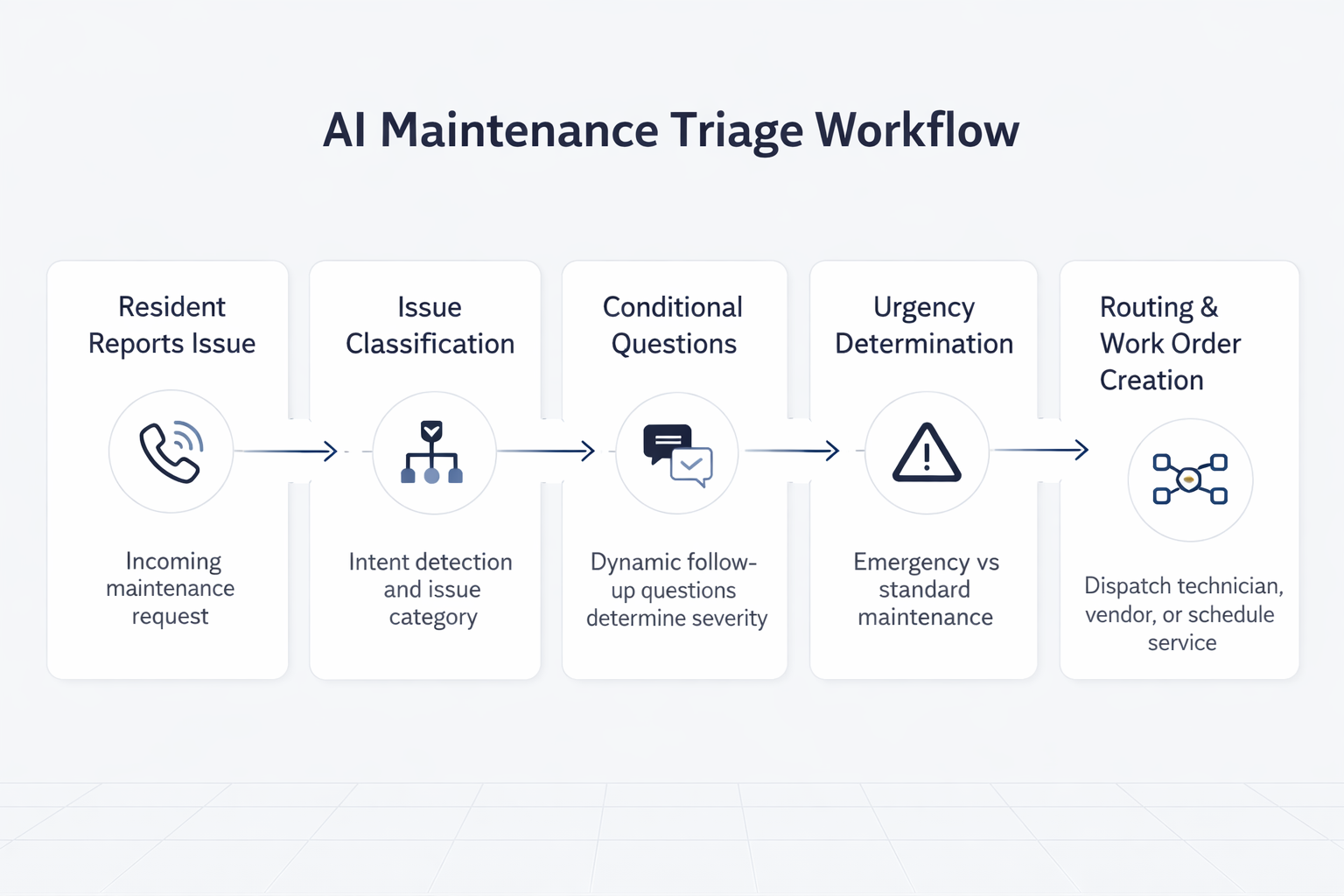
The AI triage process step by step
AI-based maintenance triage follows a structured sequence designed to classify the issue before routing it.
1. Issue identification
The system first identifies the type of maintenance request being reported. This classification typically begins with intent detection based on the resident’s description of the issue.
Examples may include:
- Water leak
- Heating or cooling issue
- Electrical outage
- Appliance malfunction
- Lockout or access issue
Intent classification allows the system to determine which triage pathway to follow.
2. Conditional questioning
After identifying the issue category, the system asks a sequence of follow-up questions designed to clarify severity.
For example, a water leak report may trigger questions such as:
- Is the water actively flowing?
- Is the leak affecting multiple units?
- Has the main water valve been shut off?
- Is there visible property damage occurring?
Each response feeds into a predefined escalation logic model.
Unlike static call scripts, conditional questioning adapts dynamically based on the answers provided.
3. Emergency classification
Once the necessary context is gathered, the system evaluates the request against predefined emergency thresholds.
Examples of emergency criteria may include:
- Active flooding
- Gas smell detection
- Electrical hazards
- Complete HVAC failure during extreme weather
- Security or access issues affecting safety
If the issue meets escalation criteria, the system routes the request according to the property’s emergency protocol.
If it does not meet emergency thresholds, the request is scheduled for standard maintenance response.
Consistency in emergency classification is one of the primary operational advantages of structured triage systems.
4. Structured work order creation
Once classification is complete, the system generates a structured maintenance record.
This typically includes:
- Resident information
- Unit number
- Issue category
- Severity classification
- Time of report
- Transcript or structured notes
- Escalation status
This information is then recorded directly in Scaalr as a structured work order.
This eliminates the need for manual re-entry the following day.
5. Routing and escalation
After classification and documentation, the system routes the request based on the property’s operational configuration.
Possible routing pathways include:
- On-call technician dispatch
- Vendor notification
- Property manager escalation
- Next-day maintenance queue
Routing rules can be configured at the portfolio level so that the same escalation logic applies across multiple properties.
Centralized routing improves consistency and reduces decision variability across teams.
Why traditional intake often breaks at scale
In many property management organizations, maintenance triage depends on human interpretation of resident descriptions.
Two agents receiving the same report may classify the issue differently. One may escalate immediately, while another may log the request for standard follow-up.
Answering services often rely on scripted prompts with limited follow-up questioning. Because agents aim to minimize liability, escalation thresholds may shift toward over-escalation.
Over time, this produces several operational side effects:
- Increased after-hours dispatch costs
- Inconsistent escalation decisions
- Incomplete maintenance documentation
- Morning re-triage workload for staff
As portfolios grow beyond 1,000 units, these inefficiencies compound quickly.
Structured AI triage frameworks are designed to standardize intake across properties.
Operational benefits of structured triage
AI-based maintenance triage systems improve operational consistency in several ways.
Consistent escalation logic
Every request is evaluated using the same emergency criteria, reducing variability between agents.
Structured intake data
Maintenance records include complete information, allowing technicians to arrive with appropriate context.
Reduced re-triage workload
Because requests are structured at intake, property staff spend less time clarifying issues the next day.
Portfolio-level standardization
Operational rules can be applied consistently across all properties within a portfolio.
This standardization becomes increasingly important as organizations expand.
The operational advantage is not simply answering calls. It is ensuring that each request is classified, documented, and routed consistently across the entire portfolio.
When structured triage becomes necessary
AI-based triage frameworks are most relevant when operational complexity increases.
Typical indicators include:
- Portfolios exceeding 1,000 units
- Multiple properties managed under centralized operations
- High after-hours call volume
- Frequent emergency dispatch costs
- Maintenance teams experiencing inconsistent issue descriptions
At this stage, the operational challenge is no longer simply answering calls. The challenge is classifying requests consistently and routing them efficiently.
Structured triage systems are designed to address that problem.
US and Canada considerations
Maintenance triage processes are largely consistent between US and Canadian multifamily portfolios. However, some operational considerations may vary.
US operators often prioritize vendor dispatch compliance, structured intake, and SOC-aligned operational logging. Canadian operators may place additional emphasis on data residency transparency and provincial privacy regulations.
These regulatory differences do not significantly alter triage workflows, but they can influence data storage decisions.
Summary
Maintenance triage determines how quickly and accurately property teams respond to resident issues. When classification is inconsistent, operational friction increases and emergency responses become unpredictable.
AI-based triage systems apply structured decision frameworks to every maintenance request. The system gathers context, determines urgency, creates structured records, and routes the request according to predefined workflows.
For property management organizations operating at scale, the operational advantage is not simply answering calls. It is ensuring that each request is classified, documented, and routed consistently across the entire portfolio.
For a broader operational framework, see: 24/7 AI Phone Coverage for Property Management
See the full operational framework: AI Property Management Operational Framework.